FOR IMMEDIATE RELEASE:
NM Livestock Board Contact: Dr. Samantha Holeck
State Veterinarian
Samantha.Holeck@nmlb.nm.gov | 505-841-6161
NMDA Contact: Candie Sweetser
Public Affairs Director
csweetser@nmda.nmsu.edu | 575-339-5037
November 2, 2026
**For ongoing updates on surveillance and infested zones, visit ScrewwormNM.org. New cases will be announced upon confirmation in areas of the state not previously identified as infested.**
NM shifts to regional zone maps as more cases of New World screwworm are detected
LAS CRUCES – New Mexico animal health officials have shifted to regional New World screwworm-infested zone maps because detections have recently expanded in the southern part of the state.
Expanding the infested zone will strengthen surveillance and help prevent the pest from spreading. This designation will not affect most residents’ day-to-day activities, but it will help animal owners understand when additional inspections or movement requirements may apply to livestock, horses, pets, and other animals.
The new zone map encompasses all of Doña Ana, Grant, Hidalgo, Luna and Otero counties, and portions of Catron, Chaves, and Sierra counties.
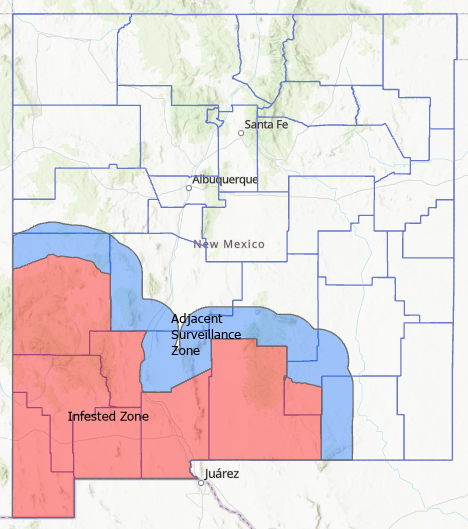
An infested zone, extending at least 12.4 miles around an affected location, is established to support surveillance and prevent the pest from spreading.
Cases were confirmed in five counties over the weekend, including newly affected areas in Catron County and in northern Otero County.
“Due to the continued increase in cases in the area, it was decided to move to a county- or regional-zone system to make it easier for everyone affected to know the boundaries of the infested zone,” said State Veterinarian Dr. Samantha Holeck with the New Mexico Livestock Board.
Residents should consult the current infested-zone map at ScrewwormNM.org to determine whether their property falls within a designated zone.
Infested zones do not restrict residents’ everyday activities. However, specific requirements apply to animals from these zones. Before moving animals out of an infested zone, they generally must be inspected within five days of the move, meet identification requirements, and receive treatment if required. Additional documentation or approval may also be needed. Animal owners should check current requirements and contact the New Mexico Livestock Board before moving animals from an affected zone.
New World screwworm flies lay eggs in wounds or other openings in living tissue. After hatching, the larvae feed on living tissue and, if untreated, can cause serious injury or death. Infestation can affect livestock, wildlife, and pets, and, in rare cases, people.
Signs to watch include:
- Wounds that fail to heal or become progressively worse
- Maggots in wounds or other body openings.
- Foul-smelling discharge from wounds.
- Unusual irritation, discomfort or signs of pain around an injury.
Anyone who observes these signs in an animal should avoid handling or moving the animal and contact the New Mexico Livestock Board immediately. Anyone who suspects an infestation should seek prompt medical attention.
“As we work to protect animal health and raise awareness of New World screwworm in the state, we are also working to reduce confusion,” said New Mexico Secretary of Agriculture Jeff Witte. “The new regional zone maps should help people determine whether they are in an area where moving their animals will require an inspection.”
For ongoing updates on surveillance and infested zones, visit ScrewwormNM.org.
###
The New Mexico Department of Agriculture benefits the public by promoting the viability and advancement of New Mexico agriculture and related industries. The agency promotes a fair marketplace, food safety, marketing, and economic development; supports the beneficial use and conservation of natural resources; and works cooperatively with the public and private sectors.
Find us at:
NMDeptAg.nmsu.edu
Facebook, X, Instagram: @NMDeptAg
YouTube: NMDeptAg | LinkedIn: New Mexico Department of Agriculture